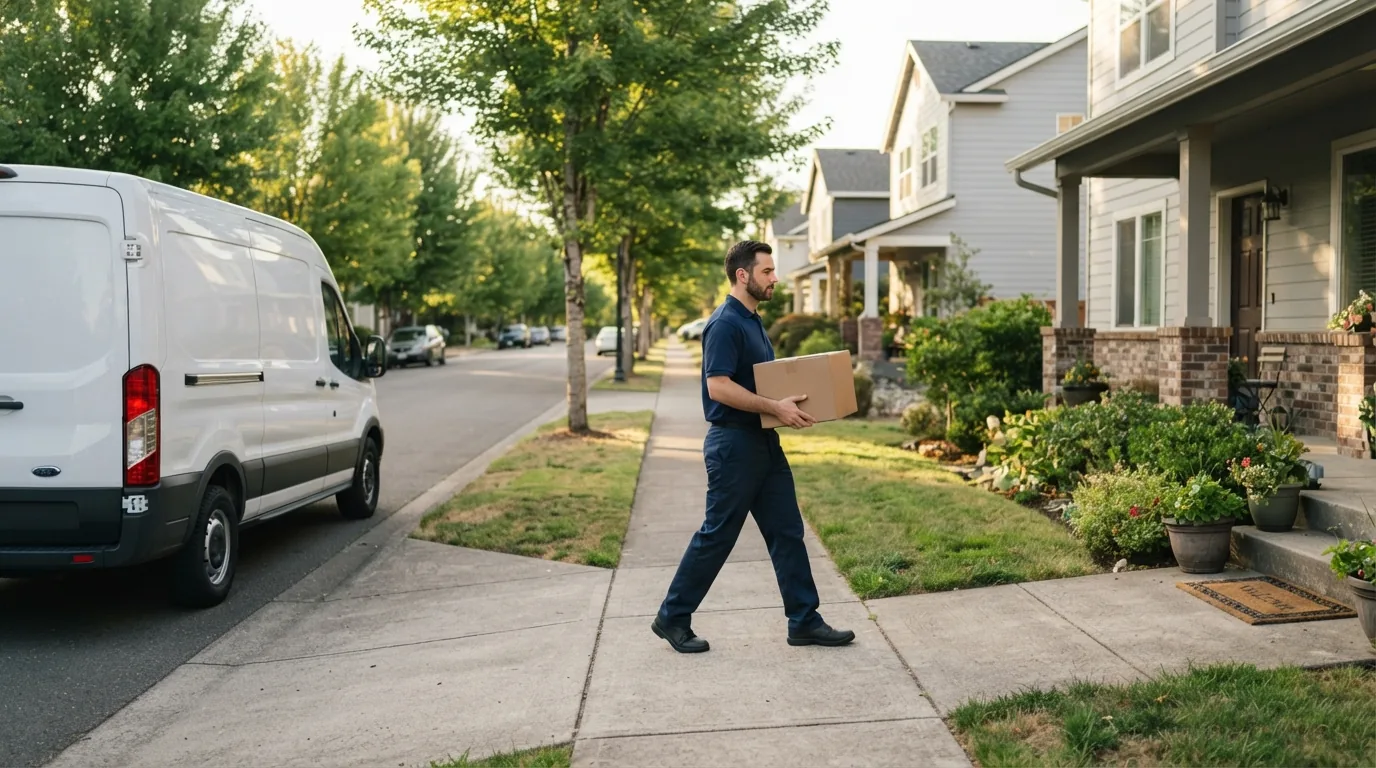
Delivery driving is one of the most visible jobs in America. Every package on a doorstep, every grocery order, and every supply delivery to a small business got there because a driver planned a route, loaded a vehicle, and made the stops. For people who prefer working on the road to working at a desk, it can be a solid career — but not every delivery job works the same way, and the differences matter for your pay, your vehicle, and your daily life.
This guide explains the main types of delivery work, what a day on the road is actually like, what employers require, how hiring works, and how to avoid the scams that target delivery job seekers.
The Main Types of Delivery Driver Jobs
Delivery work falls into a few broad groups. The posting should make clear which one you are applying for — if it does not, ask.
- Light truck and van drivers — the most common type of delivery driver, according to the BLS. These drivers — often called pickup and delivery (P&D) drivers — drive small trucks or vans from a distribution center or store to homes and businesses, following a set schedule. Some make one load-out in the morning and run stops all day; others make several trips back to the depot.
- Driver/sales workers — delivery drivers who also handle sales tasks: recommending products to businesses, taking orders, and sometimes signing up new customers along a route. Food and beverage distribution and wholesale supply are common examples.
- Courier and messenger drivers — drivers for courier companies and delivery services, moving parcels and documents on tight schedules. The BLS lists couriers and messengers as the largest employer group for light truck drivers.
- Retail and grocery delivery drivers — drivers delivering orders from a store directly to customers, sometimes using a company vehicle and sometimes their own.
- App-based and independent delivery work — drivers who find delivery tasks through smartphone apps, often using their own vehicles, and who may be classified as independent contractors rather than employees. This is a different arrangement from a staff driving job — see the section below before you sign up.
The BLS describes delivery truck drivers and driver/sales workers as workers who pick up, transport, and drop off packages and small shipments within a local region or urban area, driving trucks weighing less than 26,001 pounds in total. Heavy, long-haul trucking is a separate occupation with different licensing, and it is not covered in this guide.
What a Day on the Road Is Really Like
A delivery day is a mix of driving, lifting, and customer contact — and the balance changes with the route.
Mornings start with loading. Most drivers begin at a depot, warehouse, or store: checking the vehicle, loading cargo in delivery order, reviewing the route, and confirming paperwork or delivery instructions. How the load is organized in the morning shapes the whole day.
Routes are planned, but the road is not. Some drivers follow a regular daily or weekly route; others receive instructions for each delivery location and plan the best route themselves. Either way, you need to know the local streets, including which roads allow trucks and which do not. Traffic, weather, roadwork, and customers who are not home all change the plan. The BLS notes that driving in congested traffic or keeping to strict delivery timelines can be stressful, and that patience matters in this work.
The job is physical. Delivery driving is not just sitting behind a wheel. The BLS describes it as physically demanding: drivers do a great deal of lifting, carrying, and walking when loading and unloading, and light truck drivers have one of the highest rates of injuries and illnesses of all occupations, from lifting heavy objects and from vehicle accidents. Use proper lifting technique, take the time to load safely, and report vehicle problems rather than driving through them.
Customers are part of the job. Drivers talk with customers, confirm delivery needs, handle paperwork such as receipts or delivery confirmations, and sometimes accept payment. A calm, professional manner at the door matters — for driver/sales workers, it is also how new business is won.
Hours can be long and irregular. The BLS reports that most drivers work full time, some work more than 40 hours a week, and schedules often include weekends and holidays. Drivers with regular routes sometimes start very early or finish late — a driver supplying a deli, for example, must arrive before the shop opens. Ask about start times, weekend expectations, and overtime before you accept a role.
What Delivery Driver Jobs Pay
Pay varies by employer, location, type of driving, and whether the role is an employee position or independent work, so always check the pay in the actual posting. For a national reference point, the U.S. Bureau of Labor Statistics reports the following median annual wages for May 2025:
- Delivery truck drivers and driver/sales workers (overall): $43,950 per year ($21.13 per hour). Half of workers earned more than this amount and half earned less.
- Light truck drivers: $44,860 per year.
- Driver/sales workers: $38,770 per year.
Some driver/sales workers receive tips in addition to hourly wages — the BLS gives pizza delivery workers as an example — and some receive commissions on products they sell.
Industry matters too: in May 2025, the BLS reported a median of $47,700 for light truck drivers in courier and messenger services, compared with $34,350 in retail trade. These are national medians, not guarantees; your actual pay depends on the employer and the area.
On outlook, the BLS projects overall employment of delivery truck drivers and driver/sales workers to grow 7 percent from 2025 to 2035 — much faster than the average for all occupations — with about 152,700 openings projected each year on average, mostly to replace workers who change occupations or leave the labor force. The BLS links this growth to continued e-commerce growth, demand for faster and more convenient delivery, and the use of mobile ordering apps for groceries, takeout, and other goods.
Employee Job or App-Based Work? Know the Difference
This distinction affects your income, costs, and protections, and many new drivers do not think about it until something goes wrong.
Employee positions come with a set schedule, a company vehicle or a vehicle provided for the route, and the employer’s insurance and payroll handling. You are paid wages, and the employer covers the vehicle, fuel, and maintenance for work driving.
App-based or independent work usually means you use your own vehicle, pay for your own fuel, insurance, and maintenance, and choose when you work. Pay may come per delivery, per task, or per hour worked, and it can vary widely from day to day. Before starting this kind of work, check the real costs: fuel, wear and tear, commercial-use insurance requirements, and taxes, since independent workers generally handle their own tax reporting. Read the platform’s terms carefully, and never accept a role where you must pay to access deliveries or buy equipment before you have earned anything.
Neither arrangement is automatically better. Employee roles usually offer steadier hours and fewer personal costs; independent work usually offers more control over your schedule. Choose based on your vehicle, your budget, and how much income stability you need — and make sure you know which arrangement a posting actually offers before you apply.
Requirements: What Employers Actually Ask For
According to the BLS, delivery truck drivers and driver/sales workers typically need a high school diploma or equivalent to enter the occupation, although some opportunities exist for those without one. Workers undergo one month or less of on-the-job training. Beyond that, employers commonly require:
- A valid driver’s license from the state where you work. This is a baseline requirement for every delivery driving role.
- A clean driving record. The BLS states this directly: drivers must have a clean driving record. Expect the employer to check it. Recent serious violations, suspensions, or at-fault accidents can disqualify you — requirements vary by employer and insurer, so ask if you are unsure.
- Minimum age. Often 18, but many employers and insurers set higher minimums, especially for company vehicles. The posting will state the requirement.
- Physical ability. Lifting, carrying, and walking throughout the day, up to the weight the posting lists.
- Background check and drug screening. Many employers require one or both.
- A clean, professional manner with customers. You represent the company at every stop.
Most local delivery roles use vans and small trucks and require a regular driver’s license, not a commercial driver’s license (CDL). The BLS notes that delivery drivers drive trucks weighing less than 26,001 pounds. Some roles involving larger vehicles do require a CDL — the posting will say so, and obtaining a CDL requires passing written, skill, and vision tests. Never pay a third party for a “guaranteed” license or certificate; licensing is handled through your state.
New drivers are usually trained on the job, sometimes by a driver-mentor who rides along to make sure the new driver can operate safely on crowded streets. Training also covers company policies on drop-offs, returns, payments, and damaged goods.
How to Get Hired: A Practical Step-by-Step
- Check your driving record first. If you have violations, find out what is on your record before you apply, so there are no surprises during the employer’s check.
- Decide what kind of delivery work fits your life. Company vehicle or your own? Fixed route or flexible app work? Early starts or evenings? Your answers narrow the search quickly.
- Apply through verified channels. Use the employer’s own careers page or a reputable job board, and verify any recruiter who contacts you (see the scam section below).
- Prepare a short, focused resume. One page. List driving experience, any delivery or customer-facing work, your license type and state, your driving record in general terms (“clean driving record” only if true), and your availability. Include any experience with route planning, handheld devices, or cash handling.
- Be ready for a driving check. Many employers include a road test, a ride-along, or a vehicle inspection as part of hiring. Drive the way you would on the job: calm, observant, and within the rules.
- Ask the right questions before accepting. What vehicle will I drive, and who maintains it? Is fuel covered? What is the route area and the typical number of stops? What are the start times and weekend expectations? How is pay calculated — hourly, per stop, per delivery, or salary? Is this an employee role or independent contractor work? Get the answers in writing.
- Confirm the offer in writing. Start date, pay structure, schedule, location, and who to report to — in an offer letter or confirmation email from the employer’s real domain.
Interview and Road Test Tips
Delivery interviews often combine a conversation with a practical driving assessment. Hiring managers want to know you can drive safely, handle customers well, and manage a route without constant supervision.
Arrive early, license in hand. Bring your driver’s license and any documents requested. If a road test is scheduled, arrive ready to drive.
Talk about safety first. Mention your clean record, your habit of checking the vehicle before driving, and how you handle bad weather or heavy traffic. Safety is the top concern for any employer putting you in their vehicle.
Give real examples. “I delivered catering orders across town for a year, handled cash and card payments, and never missed a delivery window” says more than “I am dependable.”
Show you can handle the customer side. Describe a time you solved a problem politely — a wrong address, a missing item, an unhappy customer. Delivery drivers are the face of the company.
Ask about the route and the vehicle. Asking how routes are assigned, what happens when a delivery cannot be completed, and how vehicle problems are reported shows you understand the job.
Watch Out: Delivery Job Scams and Red Flags
Delivery jobs attract scams because they promise quick starts and flexible work. The U.S. Federal Trade Commission (FTC) warns job seekers to watch for these signs:
- You are asked to pay for the job. The FTC states that honest employers, including the federal government, will never ask you to pay to get a job. Fees for training, a route, a vehicle deposit, equipment, or a background check from an unverified “recruiter” are a major red flag.
- You receive a check and are told to send part of it back. This is the fake-check scam. The check will bounce, and your bank will expect you to repay the full amount. A real employer never sends you money and asks you to forward part of it or buy gift cards with it.
- The pay sounds far above normal for the work. The FTC warns that a job promising a lot of money quickly for little effort is almost certainly a scam. Compare the offer against the BLS figures in this guide and similar local postings.
- The “job” is reshipping packages. Being paid to receive packages, repackage them, and forward them — often overseas — is a reshipping scam, not a real job. The FTC warns that reshipping is never a legitimate job.
- Interviews happen only by text or chat app, with no verifiable company. Be cautious of recruiters who will not do a voice or video call, who use free email addresses, or who cannot point you to a real company website and a posting on it.
- You are asked for sensitive information too early. Never share your Social Security number, bank details, or copies of ID documents before you have verified the employer and received a genuine offer through a trusted channel.
If a listing worries you, verify it: search the company name plus “scam” or “complaint,” check whether the job appears on the employer’s own careers page, and contact the company at a number you find yourself. If you encounter a scam, you can report it to the FTC at ReportFraud.ftc.gov.
Frequently Asked Questions
Do I need a CDL to be a delivery driver?
Usually not for local delivery work. The BLS notes that delivery truck drivers drive trucks weighing less than 26,001 pounds and need a regular state driver’s license and a clean driving record. Roles using larger vehicles may require a CDL — the posting will state the license requirement, so read it carefully.
Can I use my own car for delivery work?
Sometimes. App-based and independent delivery work usually uses your own vehicle, while employee roles often provide a company van or truck. If you use your own vehicle, factor in fuel, maintenance, and insurance costs, and check whether your insurance covers commercial delivery use.
Do delivery drivers work weekends and holidays?
Often, yes. The BLS reports that drivers frequently work weekends and holidays and that schedules may vary. Delivery demand is highest when customers are home, which includes evenings and weekends. Ask about the schedule before accepting a role.
How long does training take for a delivery driver?
Usually one month or less, according to the BLS. Training typically covers the vehicle, the route area, company delivery policies, and — for driver/sales workers — product knowledge and sales techniques. Some employers pair new drivers with a mentor for ride-along training.
Ready to Look for Delivery Work?
You now know the types of delivery roles, what employers require, how pay compares nationally, and how to spot a fake listing. The next step is to browse current openings, read each posting carefully — especially the vehicle arrangement, schedule, and pay structure — and apply to the roles that genuinely fit your life.
